
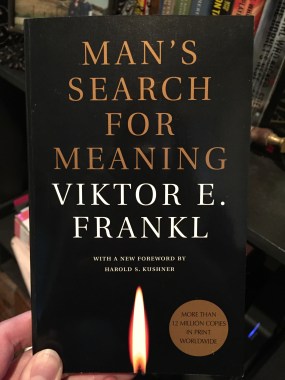
 I first heard about Viktor E. Frankl’s book “Man’s Search for Meaning” from my therapist in summer 2016. I also saw it quoted in the Harvard Business Review’s article “How Resilience Works”, by Diane Coutu (2002). Coutu briefly described Frankl’s “meaning therapy” and his experiences in the Holocaust. Frankl writes, “We must never forget that we may also find meaning in life even when confronted with a hopeless situation.” After reading that line from his book, I knew I had to read the rest. I knew there had to be a meaning to our miscarriages, and I held onto that hope in our hopeless situation. I am by no means comparing my losses to those of the Holocaust, merely praising Frankl’s strength and wisdom during what was probably the hardest time of his life.
In this gripping memoir, Frankl describes pieces of his experience in the Nazi concentration camp, Auschwitz, and how he held onto hope through it all. I read this book September 2016, after our 4th loss. I didn’t understand what the meaning was behind yet another loss. I questioned what I was supposed to learn from this and I searched for answers. I read “Man’s Search for Meaning” in a few days, I couldn’t put it down. I had read other accounts of the Holocaust (“Night”, “The Diary of Anne Frank”), but never one who’s universal messages struck me at such a hard time in my life.
The book is broken up into three sections. Below are some of my favorite quotes/lines from the first section in which Frankl gives details about his time in the concentration camp:
- “…everything can be taken from a man but one thing – to choose one’s attitude in any given set of circumstances, to choose one’s own way” (66).
- “If there is a meaning in life at all, then there must be a meaning in suffering” (67).
- “…man’s inner strength may raise him from his outward fate” (68). Love this one – it helped me to believe in my inner strength and that I could overcome our recurrent losses and the grief that comes with miscarriages.
- “But there was no need to be ashamed of tears, for tears bore witness that a man has the greatest of courage, the courage to suffer” (78). I come back to this point often. It helps remind me that it is ok to be upset, it is ok to cry, it is ok to give myself permission to feel my depth of feelings. I have the courage to accept and embrace my emotions.
In the second section, Frankl begins to explain his theory of logotherapy which focuses on the search for meaning as being one’s primary motivational force. He believes that man is responsible for finding the meaning in his life, and he lists three ways to discover one’s life meaning (111):
- “by creating a work or doing a deed”
- “by experiencing something or encountering someone”
- “by the attitude we take toward unavoidable suffering.”
He goes on to talk about how we can transform a personal tragedy into a triumph. I think this is one of the main reasons his book had such a strong impact on me. I was going through (and are still going through) a personal tragedy. If there was a purpose for our losses, I wanted to search for what that was. Over the past three years, I have learned how strong I am, how to build resilience and how to adjust my attitude to see the hope in seemingly hopeless situations. I truly believe there is a plan for me and God is showing me the meaning of my suffering. I strive to find meaning in my life by working towards the three strategies Frankl mentions in this section. His words brought me hope that my suffering wasn’t meaningless and that there was purpose behind the pain, even if I didn’t know what that was.
The final section is titled “The Case for Tragic Optimism”. Frankl defines “tragic optimism” as “an optimism in the face of tragedy and in view of the human potential” (137). I consider myself an optimistic person, and through all of our losses, I have tried to remain realistically positive and optimistic. I have remained steadfast in my belief that there is meaning in our loss and that I am meant to continue to press on and move forward, regardless of the situation. Frankl also talks about the importance of helping others and says, “the meaning of your life is to help others find the meaning of theirs” (165). I’ve always felt that drive and motivation to make a difference in others’ lives, and if through sharing my story and lessons I’ve learned about resilience is part of my life’s meaning, than I know there is meaning in my suffering.
Coutu, Diane. “How Resilience Works.” Harvard Business Review, May 2002.
Frankl, Viktor E. Man’s Search for Meaning. Beacon Press, 2006.

 Pressing On